Pianos and Thoughts
(Behind-the-Scenes Details)

Karl Popper: “All swans are white”
Sir Karl Popper (1902–1994) was an Austrian-British philosopher recognized as one of the 20th century's most
influential thinkers in the philosophy of science. He is best known for rejecting classical inductive methods
in science in favour of falsificationism. Popper argued that scientific theories can never be proven true,
only disproven; a statement must be testable and capable of being falsified to be considered scientific.
For centuries, Europeans assumed that "All swans are white" because every recorded observation of a swan in Europe confirmed
this belief. Under classical inductive logic, observing thousands of white swans accumulated evidence to strengthen the
universal statement: "All swans are white." However, in 1697, Dutch explorer Willem de Vlamingh discovered black swans
(Cygnus atratus) in Western Australia. Popper used this historical event to illustrate his core concept: no amount of white swan observations could permanently prove that all swans are white. Yet, a single observation of a black swan immediately shattered the hypothesis. (Asymmetry of verification and falsification). Science progresses not by proving theories true, but by proposing bold hypotheses and rigorously attempting to refute them.

I had wondered how Karl Popper would have evaluated "A swan is a beautiful detail of the world and the world is a beautiful detail of the universe".
He would have certainly categorised it as a metaphysical or aesthetic statement rather than a scientific one,
and a non-falsifiable one, because terms like "beautiful detail" rely on subjective human value judgments rather than
empirical measurements. That is a statement that cannot be tested or disproven through observation.
Popper did not dismiss non-scientific statements as meaningless, and this is a major distinction between him and the Logical Positivists. He viewed metaphysical ideas, art, and philosophy as valuable parts of human culture ("World 3," his term for the realm of objective human knowledge and ideas, whereas “World 2” was the psychological and cognitive one of individual perception and interpretation, and “World 1” the phisical and objective one made of matter and energy).
Many of our thoughts belong to the realm of human meaning rather than empirical science.
Karl Popper would have respected them as valid expressions of how human consciousness interprets structure and beauty
across different scales. And in this context, "structure" refers to the patterns, order, and nested relationships that the human mind perceives reality in, i.e. how a smaller part (a swan) fits harmoniously within a larger system (the world), which in turn fits inside an even greater whole (the universe). Popper viewed the human mind not as a passive recorder of facts, but as an active creator of theories, frameworks, and patterns to make sense of reality.
Karl Popper would have emphasised that a person's physical body resides firmly in World 1 (the physical realm of matter and energy), while their subjective mental experiences, such as thoughts, feelings, and consciousness, belong to World 2 (the realm of mental states).
However, he would have drawn a subtle distinction regarding World 3 (the realm of objective products of the human mind, such as theories, art, and myths): an individual’s mind itself operates in World 2, but it interacts with World 3 by creating and grasping abstract ideas. A mind does not literally "belong" to World 3, but rather uses World 3 objects (like mathematical rules or scientific theories) to shape its thoughts.
As for a swan, Popper would have happily placed its biological body in World 1 and grant that its subjective perceptual experiences, its instincts, fear, and awareness, give it a place in World 2. But he would have also clarified that a swan lacks the higher-order linguistic capability to formulate objective arguments or abstract concepts, meaning its mind cannot participate in or contribute to World 3.
And now, to put it in philosophical terms, consider the curious case of an inflatable doll: when fully inflated,
its physical vinyl body clearly occupies World 1. Yet, when completely deflated,
it loses its physical substance and exists only as a subjective desire in someone's mind (World 2)
or as an abstract concept in a manufacturer's catalogue (World 3).
Origins of skul and squola, the things that needn’t disciplinarians.
Skul:
The spelling "skul" for "school" shows up across several distinct contexts,
ranging from historical Middle English to modern global Creoles and intentional shorthand.
Historical English (Middle English Variants):
Before English spelling was standardized in the 16th and 17th centuries,
words were spelled phonetically based on local dialects.
In Old English, the word was written as scōl, which shifted to
scole, or sculle/skulin in various
Middle English manuscripts before scribes reintroduced the classical Greek/Latin ch (schola).
Tok Pisin and Atlantic Creoles:
In Tok Pisin (an official language of Papua New Guinea derived largely from English), skul is the standard, official spelling for both the noun "school" and the verb "to study" or "to educate". Many English-based Creole languages adopt phonetic spellings, stripping away silent letters like h and replacing sch/ch with k.
Phonetic Reform & Simplified Spelling:
Throughout the 19th and 20th centuries,
various spelling reform movements proposed replacing irregular spellings with strictly phonetic ones.
In these systems, removing the Greek-derived ch and double oo in favour of skul or skool
was a common proposed simplification.
Informal Shorthand & "Eye Dialect":
In modern usage, deliberate misspellings like skul or skool are often used in slang, textspeak, cartoon branding, or literature to denote child-like writing, a casual tone, or rebellion against formal education.
Squola:
In the Italian language, the form "squola" written with a Q is one of the most famous and classic spelling errors.
Beyond being a simple grammatical spelling mistake, the form "squola" holds a distinct cultural and pedagogical significance in Italian culture:
Pedagogical Value of the Error (Gianni Rodari):
Author and educator Gianni Rodari, in his famous work Grammar of Fantasy (1973) and his poem Sulla Fabbrica dei Grammatici, often treated "squola with a Q" as a creative error. For Rodari, a child's mistake shouldn't merely be punished with a red pen, but can instead serve as the starting point for a story or an opportunity to laugh and reflect on the arbitrary nature of language rules.
Satirical, Ironic, and Pop Culture Usage:
The spelling "squola" is intentionally used in modern Italian for communicative purposes.
In media coverage or social comments, writing "la squola" is used to satirize ignorance, the decline of the school system,
or incompetence in educational management. Comic writers and children's authors also use it in dialogue to denote illiteracy,
young age, or playfulness. A famous real-world example is Daniele Luchetti's 1995 film La scuola
(based on books by Domenico Starnone), where the contrast between the institution and its flaws is highlighted through
these intentional misspellings.
Childhood Learning Phase:
From a linguistic and developmental perspective, writing "squola" is a completely natural error for first-grade children. Because the sounds CU and QU are phonetically identical (homophones), children naturally apply the more common rule that links the following vowel (o) to the letter Q before memorizing the specific visual exception of the word "scuola".
Let’s be honest now: my own misspellings of "school" and "scuola" aren't some deep linguistic rebellions or a homage to Middle English scribes. I’m just a human parrot who absorbed some pop culture slang and ran with it, because if we hear a catchy misspelling enough times, our brains automatically copy and paste.
Then I wondered how popular culture and rebellious behaviours intertwine with formality and more conservative approaches to education in schools across the world today, and weather an environment of moderate competitiveness would perhaps positively prod the underachievers.
French sociologist Émile Durkheim (1858–1917), who is widely considered one of the founding fathers of modern sociology,
argued strongly against fostering a competitive spirit in schools. He believed that school is a miniature society and its
primary purpose is not merely academic instruction, but social integration, and teaching young people how to develop a
shared sense of morality and collective responsibility (what he termed social solidarity). Competition fuels selfishness,
and encouraging students to compete against one another breeds individualistic, egoistic behaviours.
In Durkheim’s view, high competitiveness isolates individuals, weakens social bonds, and undermines the mutual trust
required for a healthy society. No ranking of the students against their peers, but fostering of a
shared duty and cooperation spirit, then!
"Discipline doesn’t require disciplinarians, it requires a struggle to find yourself a useful role or make ends meet". What would he have thought about that?
Durkheim would have had a mixed, yet deeply engaged response to that, agreeing with the first half while strongly critiquing
the second. Regarding "Discipline doesn't require disciplinarians" Durkheim would have largely agreed, because he argued that
true discipline cannot be maintained through harsh authoritarian figures or fear of punishment.
Instead, it should have been internalized by the individual through a sense of moral obligation and belonging.
For Durkheim, effective discipline is a self-imposed understanding of social norms, not brute coercion.
"Finding yourself a useful role" aligns directly with Durkheim's theory of Organic Solidarity. In modern, complex societies, social cohesion relies on people performing different, specialized functions. Durkheim believed that an individual finds genuine purpose and self-discipline when they understand how their unique role contributes to the greater good of society. Finding a "useful role" is central to his vision of social harmony.
But he would have strongly rejected "a struggle to make ends meet" and the idea that discipline should stem from a raw economic struggle to survive. In fact, he warned that when individuals are driven purely by market pressures and economic desperation, society falls into a state of normlessness.
Philosophical sketches
Why do so many people sketch and paint? Does picking up a pencil or paintbrush bring back memories of school art classes?
For many artists, Plato remains an inescapable philosophical phantom, one who seems to undermine the very purpose of
creative effort. Plato (c. 428/427–348/347 BCE), the foundational thinker of Classical Athens and Western philosophy,
famously argued in The Republic that representational art is "twice removed from reality."
He posited that physical objects (like a bed) are merely imperfect copies of their ideal Forms, making a painter’s
depiction just a copy of a copy. Viewing mimetic art as deceptive, emotionally volatile, and morally dangerous,
Plato went so far as to propose banishing painters and poets from his ideal republic. His view on music was similarly strict:
while he acknowledged its powerful influence, he believed it should be strictly regulated to foster moral discipline rather
than emotional indulgence.
Aristotle (384–322 BCE), Plato’s student, offers a far more reassuring perspective for creators. In his Poetics, he argued that mimesis (imitation) is a natural human learning tool. Rather than tricking us, art simplifies and clarifies reality to reveal universal truths. For Aristotle, music and visual arts provide therapeutic value through catharsis, a purging of intense emotions, doing viewers and listeners a genuine service.
Centuries later, Arthur Schopenhauer (1788–1860) reframed art as a vital refuge from the relentless suffering driven by the
human Will (our endless, unfulfillable desires). Through aesthetic contemplation, art allows us to temporarily lose our self-absorbed ego. While visual arts depict the intermediate Forms of the world, Schopenhauer elevated music above all other arts. Because music bypasses representational form entirely, he viewed it not as a mere copy of ideas, but as a direct, universal expression of the Will itself.
In the 20th century, art historian Ernst Gombrich (1909–2001) shifted the focus to visual perception in works like
Art and Illusion. He argued that representation relies on mental schema and prior knowledge: we do not simply "see" an image, we learn to decode it. Gombrich coined the term the "beholder's share" to describe how viewers actively complete an artwork using their own expectations, memories, and cultural conventions. Just as listening to music requires an awareness of rhythm and structure, viewing visual art is an active, collaborative act between creator and audience.
Now imagine Plato, Aristotle, Schopenhauer, and Gombrich walking into an auction house where an animator is trying to sell a high-art symphony paired with a cartoon mouse.
Plato throws his hands up in despair. "A piece of music is already a copy of a divine Form, and a cartoon is a copy of a physical object! You are selling a copy of a copy of a copy! This is three steps removed from truth, and it will corrupt the youth of Athens!"
Aristotle strokes his beard and adjusts his robes. "Now, let’s be reasonable, Plato. The cartoon provides mimesis, a visual mimicry of action, which, when paired with the musical score, creates a structured plot. If the cartoon mouse undergoes a tragic downfall, it could yield an effective catharsis for the audience, provided the narrative structure has a proper beginning, middle, and end".
Schopenhauer sighs heavily, staring into his drink. "Idiots, both of you. Music is the sacred, unmediated expression of the raw, agonizing Will itself, the highest form of contemplation known to man! To chain such pure, transcendent suffering to a painted rodent slipping on a banana peel is proof that human existence is a miserable, meaningless joke".
Gombrich puts on his reading glasses and inspects the storyboard. "Fascinating! You see, the viewer's brain uses 'the beholder's share' to bridge the gap between abstract sound and graphic lines! The animator isn't depicting reality; they're creating a visual schema, testing our perceptual psychology to see if a drawn duck can make us hear a bassoon differently!"
The animator blinks at them, holds up the drawing, and asks, "So... is that a yes on the bid?"
Graffiti, a brief account.
The earliest forms of graffiti are the cave paintings of the Palaeolithic, Lascaux in France and Altamira in Spain
date to roughly 17,000–15,000 BCE. These weren't "graffiti" in the modern sense, but they represented the same fundamental human impulse to inscribe images on surfaces. Whether they were ritual, narrative, or something else is debated, but they just seem to be the oldest examples of wall-marking.
The Egyptians also left inscriptions, and the ancient Greeks left mercenary names carved into monuments, such as those on the statue of Amenhotep III in Egypt, carved by Greek soldiers in the sixth century BCE.
But the most famous and best-documented early graffiti come from the ancient cities of Pompeii and Herculaneum,
preserved by the eruption of Vesuvius in 79 CE. Thousands of inscriptions survive, scratched or painted on walls,
and they are startlingly modern in content. They include political slogans endorsing candidates for local office,
advertisements for gladiator games, love declarations, insults, and even mundane complaints.
One famous example is a rude political graffito that reads roughly "I wonder, O wall, that you have not fallen into ruins,
since you must bear the tedious writings of so many people" (Admiror, paries, te non cecidisse, qui tot scriptorum taedia sustineas). There is a related graffito, also from Pompeii, in the voice of the wall itself replying in a similar vein, which reads approximately "Scribbler, may you perish, you who refuse to yield to the wall!" (Scriptor, utinam pereas, qui non vis cedere parieti). Ancient graffiti mocking other graffiti! This shows that even in antiquity,
the debate about wall-marking already existed, with all its humour and irritation.
Graffiti continued through history in various forms. Medieval churches across Europe bear scratched markings,
pilgrim signatures, names, and small devotional images on their stonework. Ship graffiti and castle graffiti from sailors
and soldiers also survive. Historically, many of these were signatures or records of presence (I was here), a category that persists to this day.
But graffiti as we understand it today, the bold painted tags and murals, is of a different lineage, and here the
origin story is much more specific and traceable.
It emerged in the late 1960s and early 1970s in Philadelphia and then New York City.
The early innovators used markers and spray paint to write their names or nicknames repeatedly around their neighbourhoods.
In Philadelphia, figures like Cornbread are credited with beginning the trend of "tagging",
or writing one's name everywhere to gain notoriety. In New York City in the early 1970s,
this exploded along the subway system. A Greek-American teenager from Washington Heights named Demetrius,
who signed as Taki 183 (his nickname plus his street number), began tagging his name throughout the city, and when the New York Times profiled him in 1971, the practice gained massive visibility and spread rapidly.
During the 1970s and 1980s graffiti developed rapidly from simple tags into an art form: large, complex,
multi-coloured works that could take hours and required considerable skill started to emerge.
Artists began decorating the entire cars of subway trains and competing for fame, developing recognizable styles and elaborate lettering. By the late 1970s and 1980s, graffiti had crossed from the trains into the art world: figures like Jean-Michel Basquiat (who began under the tag "SAMO") and Keith Haring moved from street marking to galleries, and photographers and films like Wild Style (1983) documented the culture for a wider audience.
Then Graffiti became one of the four elements of hip-hop alongside MCing, DJing, and breakdancing, giving it a cultural framework and identity. Cities began aggressive anti-graffiti campaigns, while simultaneously some municipalities commissioned legal murals, a tension between vandalism and public art that persists.
In the 1990s and 2000s, a related but distinct movement emerged, street art, using stencils, stickers, wheatpasting, and installations rather than just lettering. Figures like Banksy brought this style global fame and shifted public perception of wall art away from vandalism toward legitimate and highly valued contemporary art.
From a linguistic point of view, note that the word graffiti ultimately originates from the ancient Greek verb graphein.
Graphein meant to scratch, to draw, to write, or to incise.
In antiquity, these actions were often done with the same tool: a stylus (graphion in Greek). A stylus was a sharp, pointed implement used to write on wax tablets or, significantly, to incise marks onto harder surfaces like pottery, wood, or stone. Because the tool itself performed a range of actions from light scratching to deep cutting, the verb describing its action covered that entire spectrum.
When this root moved into Italian, it evolved into different branches. Graffiare became the primary
verb focusing specifically on the action of making a light mark (often accidental or shallow,
like a fingernail or a claw mark). A different derivative of the ancient Greek stylus, graphium,
passed through Latin and gave rise to standard Italian words related to writing (grafia), illustration (grafica), and eventually, drawing (disegno). By the Medieval period, the literal verb
graffiare was distinct from the literal verb "to carve" (scolpire) or "to write" (scrivere).
The modern word "graffiti" as we use it today didn't exist until 1851.
It was coined by British archaeologist George Dennis. While exploring the ruins of Pompeii,
he was struck by the sheer quantity of spontaneous, unofficial drawings and writings scratched onto the plaster walls.
They ranged from shallow doodles to political slogans and poems. Dennis needed a new scientific term to categorize these
markings, distinguishing them from official inscriptions carved by stonemasons on stone monuments (which were already
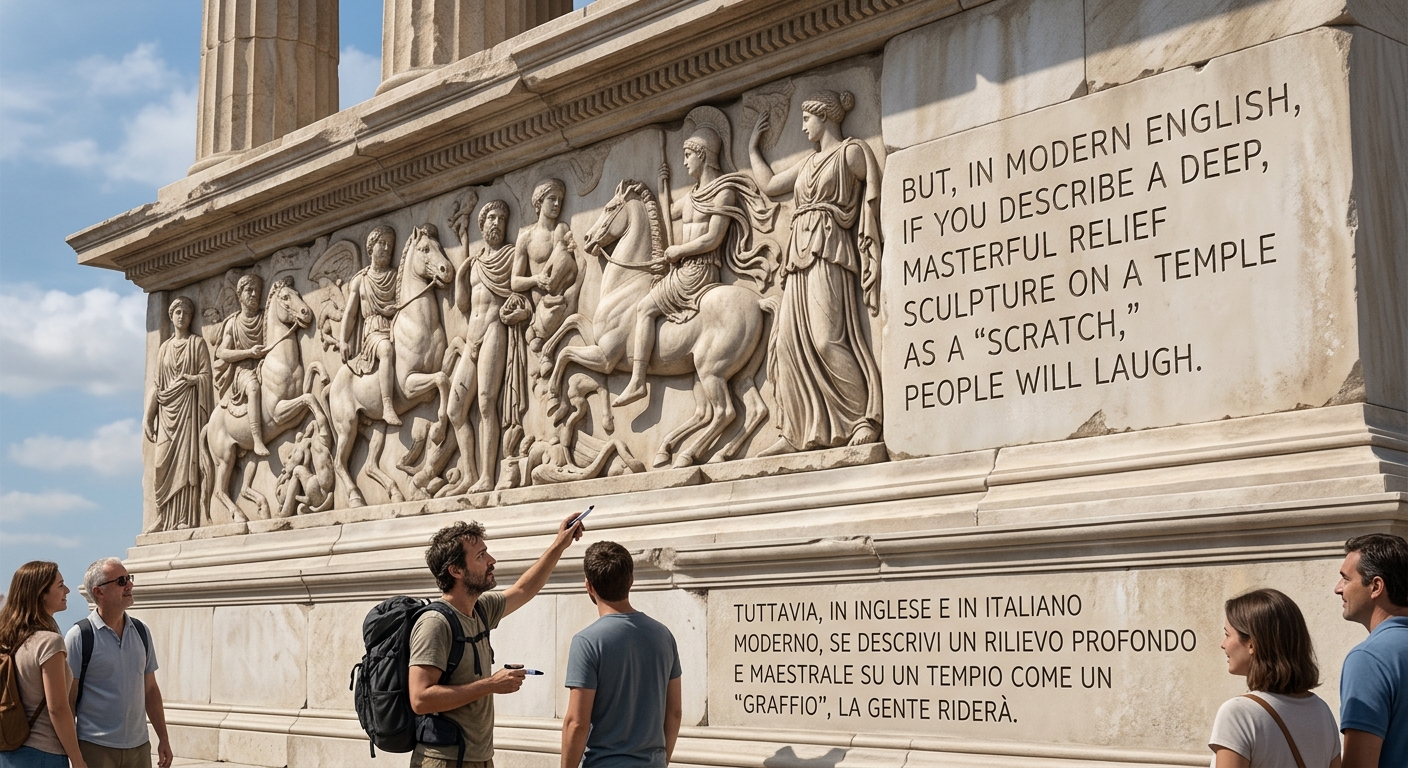
called epigraphs or inscriptions). He turned to Italian. He saw the plural of graffio (a scratch) and decided that
graffiti ("scratches" or "scratched things") was the perfect descriptor for this spontaneous, unofficial,
wall-scrawling habit.
An archaeologist used a term meaning scratch to categorize a
widespread human behaviour that included writing, scratching, doodling, and incising,
simply because "unofficial scratch mark" was a good enough descriptor to separate it from "official
monumental carving".